
In hymnody, “There is a Happy Land” might be considered a one-hit wonder. While unknown to most modern church-goers, the hymn one of the most popular nineteenth century hymns in American and British Sunday schools.
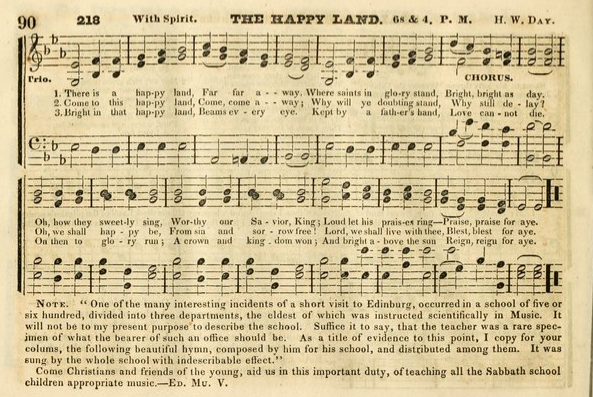
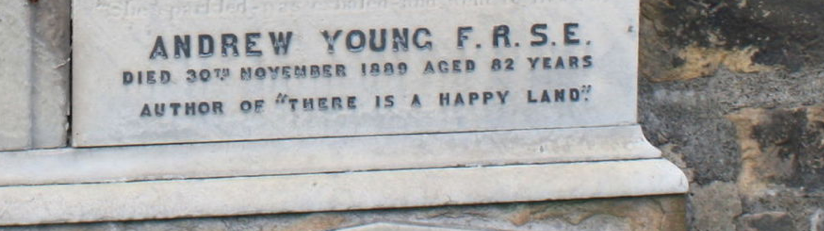
School teacher Andrew Young (1807-1889) wrote “The Happy Land” in 1838. Young was a teacher and then a headmaster in Edinburgh and St. Fife, Scotland. As a poet he wrote hymn texts for Sunday school students, some of which reached wider audiences. Young (1876) recalls spending time with friends when he heard woman playing an “Indian air” at the piano, which he says “charmed me exceedingly” (vi). The tune stuck with him and soon after he the wrote three rhyming stanzas of “The Happy Land” in the middle of the night.
There is still some confusion regarding the origin of the tune that Young heard, now called Happy Land. Young claims that he heard the tune as part of a piano piece called the “Siege of Dehli,” but this music reflects on an event in 1857, almost 20 years after he heard the tine. Griffiths (1904) suggests that there may have been another piece of music written about Dehli in the early nineteenth century, with similar melodic ideas (p. 41). Alternatively, modern hymnology suggests that the tune was written by Robert Archibald Smith with the words “I have come from a happy land”, different than Young’s text (Cokrell, 2011). Early twentieth century American sheet music for this song attributes to a “Hindostan [Indian] air.”
Despite being membered only for “There is a Happy Land”, Young was a prolific poet and frequently contributor to poetry journals. Julian (1892) writes that “his poems entitle him to rank in the first order of Scottish minor poets.” Young’s book The Scottish Highlands and other Poems (1876) contains many beautiful hymn texts and poems.

Fortunately, Young was able to watch his famous hymn spread around the world through the work of Presbyterian missionaries such as Jon Ingills (Julian 1892). The song was first popularized by Rev. James Fall in his Sacred Song Book (1843) and after a few decades, it appeared in hundreds of hymnals in America and the UK and in translation by members of the London Missionary Society (L. M. S). Griffiths (1904) writes:
Of all the Sunday School hymns which attained world-wide popularity, there is perhaps not one that is more generally liked than that of the commencing ‘There is a happy land.’ From our earliest childhood, and the singing of it brings back vividly all the hallowed associations of that happy time… (41).
Butterworth and Brown (1906) give further praise: “his little carol had become one of the universal hymns”. In gratitude for the using the hymn Young (1876) writes that “the anecdotes which have reached me of the blessing it has proved to both young and old, in many lands, have been to me a source of the highest gratification and thankfulness” (p. vi).
The hymn has been referenced in many times in popular cultural including the in an issue of the comic strip Krazy Kat, the Mark Twain novel The American Claimant (1892) and the films The King and I (1956) and The Proposition (2005). Despite its “universal acclaim,” the hymn is not nearly as popular today as it once was. The website hymnary.org lists 539 hymnals containing “There is a Happy Land”, but only three of these were compiled after 1970.
The three-stanza hymn is an invitation to heaven. An irregular ABAACCCA rhyme scheme is punctuated in the middle section of the tune.
There is a happy land, far, far away,
Where saints in glory stand, bright, bright as day;
Oh, how they sweetly sing, worthy is our Savior King,
Loud let His praises ring, praise, praise for aye.
Come to that happy land, come, come away;
Why will you doubting stand, why still delay?
Oh, we shall happy be, when from sin and sorrow free,
Lord, we shall live with Thee, blest, blest for aye.
Bright, in that happy land, beams every eye;
Kept by a Father’s hand, love cannot die;
Oh, then to glory run; be a crown and kingdom won;
And, bright, above the sun, we reign for aye.
The first stanza introduces a distant realm (the “happy land”) where the saints worship the savior on his thrown (see Revelation 4-5, 7). The text urges the listener to join the throng (“Why will you doubting stand, why still delay?” and “Oh, then to glory run”) and shares a feeling of happiness brought by redemption (“sin and sorrow free”; Rev 7:14). The third stanza share some of the aspects of this other realm: perpetual love (“love cannot die”), saints with crowns (Rev. 4:4) and light brighter than the sun (Rev. 21:23). Similar texts with “heavenly” themes including the last verse of “Amazing Grace,” starting “when we’ve been there ten thousand years”, the saints “casting down their golden crowns” in “Holy, Holy, Holy” (Rev. 4:9).
Reflection Questions:
- What do you remember from your Sunday school experience? Were there any themes or lessons that stuck with you?
- Are there any hymns that you consider “universal hymns”, which are familiar and well-liked by many Christian audiences?
- The tune for “There is a Happy Land” may have been known to common people as a “song of the day”. Many of Luther’s hymns were also based on popular songs. What role does popular music play in worship in modern churches? What role should it play?
- How do you think Young felt knowing his song had such an impact? The Apostle Paul lists several “spiritual gifts”. Do you recognize any of these gifts in yourself or others? (See also: Romans 12:6–8, 1 Corinthians 12:8–10 and Ephesians 4:11).
And God has appointed in the church first apostles, second prophets, third teachers; then deeds of power, then gifts of healing, forms of assistance, forms of leadership, various kinds of tongues.
1 Corinthians 12:28